Hex
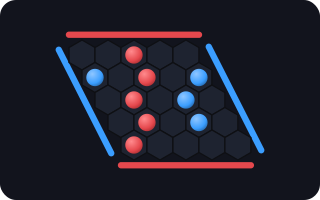
The classic game of Hex against a Monte-Carlo AI. Place RED stones to connect top and bottom before the AI links left and right with BLUE. Full two-way swap (pie) rule, undo, highlighted winning path and three board sizes 7×7 / 9×9 / 11×11 — Hex can never end in a draw.
Hex is a beautifully simple connection game with surprising strategic depth. You place stones on a rhombus of hexagons, trying to build an unbroken chain across the board before the AI completes its own. Because Hex can never end in a draw, every game drives toward a decisive, satisfying conclusion.
How to play
Take turns placing stones with a Monte-Carlo AI opponent. You play RED and aim to connect the top and bottom edges, while the AI plays BLUE and tries to link the left and right edges. The first player to form a continuous chain between their two sides wins. A two-way swap (pie) rule, undo, a highlighted winning path, and board sizes of 7×7, 9×9, and 11×11 are all available.
Tips
- Play toward the centre early — central stones support connections in more directions.
- Remember that blocking your opponent and building your own chain are often the same move.
- Use the swap rule wisely: a very strong opening move can be turned against you.
- Look several moves ahead for "bridge" links that are hard for the AI to cut.
For more head-to-head board strategy, line up stones in Gomoku or take on the full game of Chess.
Objective
Connect the two RED edges (top and bottom) with an unbroken chain of red stones before the AI connects the BLUE edges (left and right). By the Hex theorem a full board always has exactly one winner — draws are impossible.
Controls
- Tap / click an empty hexagon to place a stone
- ⇄ Swap (pie rule): right after the FIRST move of the game, the second player may steal it — the stone flips color and mirrors its position. The AI will swap too if your opening is too strong!
- ↶ Undo takes back one pair of moves (yours + the AI's reply)
- New: pick who moves first (you / AI / random) and start a fresh game
Tips
- Bridge: two stones placed a diagonal step apart share 2 empty cells — if the opponent blocks one, you take the other, so the link is virtually secure
- A central opening is so strong the opponent should swap it. If you move first, open slightly off-center so the AI declines the swap
- Don't chase individual stones: think in whole connections, block from a distance and use your own two edges as allies