Games › 🧩 Puzzle › Slitherlink
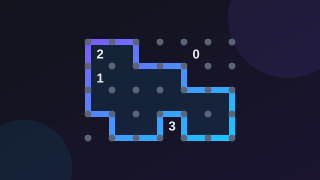
Slitherlink
Draw a single closed loop on a dot grid so that every numbered cell has exactly that many of its edges on the loop. The classic Loopy-style logic puzzle — every level is procedurally generated with a guaranteed unique solution, in an endless campaign per difficulty.
Slitherlink is a classic Loopy-style logic puzzle where you draw a single closed loop around a grid of dots. Numbered cells tell you exactly how many of their edges the loop must use. It is a quiet, purely deductive challenge, and every level is procedurally generated with a guaranteed unique solution.
How to play
Tap or click an edge to cycle it: first a line segment, then an ✕ to rule it out, then blank again (right-click marks ✕ quickly). Your goal is one non-crossing, non-branching loop where every numbered cell touches exactly that many loop edges. Use ✓ to highlight contradictions, the 0× button to auto-mark zeros, and ⚙ for custom boards.
Tips
- A 0 cell has no loop edges at all — cross out all four of its sides immediately to open up the board.
- A 3 in a grid corner always has its two outer edges on the loop, giving you a reliable starting foothold.
- Two adjacent 3s share a used edge, plus the two opposite outer edges are also on the loop.
- Every dot has exactly zero or two lines through it, so a single dangling segment must always continue.
If you like loop and line logic, try Nonogram or the number deduction of Sudoku.
Objective
Draw ONE single closed loop (no crossings, no branches) so that every numbered cell has exactly that many of its edges on the loop.
Controls
- Tap/click an edge: 1st tap draws a line ─, 2nd marks × (ruled out), 3rd clears it
- Right-click: quick × mark
- ↶/↷ Undo / Redo
- ✓ Check: highlights contradictions in red
- 0×: auto-mark × around every 0 cell
- ↺ Restart level, ⚙ Custom puzzle (size 4–12, clue density)
Tips
- A 0 cell: none of its 4 edges belong to the loop — cross them all
- A 3 in a grid corner: its 2 corner edges are always on the loop
- Two adjacent 3s: the shared edge and both outer opposite edges are on the loop
- Every dot has 0 or 2 line segments through it — a dead end must continue
- A red number means that cell already has TOO MANY lines — remove some